Adapting to Life’s Obstacles: How to Thrive with a Positive Mindset

From the beginning of evolution of life on this planet if there was one thing which remained consistent, it was the challenges it brought to the group that was trying to survive and thrive.

If you are someone who believes (or does not) in the Darwinian theory of evolution, you will know how the evolution came about and how human beings ended up here. The mechanism that Darwin proposed for evolution is natural selection “Because resources are limited in nature, organisms with heritable traits that favour survival and reproduction will tend to leave more offspring than their peers, causing the traits to increase in frequency over generations

Something that was felt by and survived by all the organisms who thrived were the same challenges that their environment and the conditions threw at them. And on the other hand, the one’s which did not survive also had to face the same exact challenges but could not handle them well or overcome them.

The bad news is, we will also face challenges (if not already, which I highly doubt) as our ancestors did, and so would our future generations without any exceptions regardless of we liking it or not. But the good news is, we can overcome it and we have what it takes to adapt, survive and thrive. Let’s find out how!

Challenges can be broadly split into 2 types –
Internal – Mental
External – Physical

While most of the external challenges we face every day, every minute in our lives are external but how we react to them is based on our mental state and how we deal with them. It is that mental state that decides if we will survive, thrive or perish.

With ever increasing challenges in the world, it becomes harder for an individual to get back to his normal state as soon as it is ideal to do so. The connected world keeps throwing things at him to keep him in that negative zone forever, if he does not become aware of where it is leading him and takes charge of the situation.
Take any social media for instance, you constantly are bombarded with all the so called “great” things people are able to achieve and do in their jobs, life, family. And looking at all that you start to feel that you are not “there” yet and start questioning your abilities and life.

The challenge arise when you as an individual are already facing inner turmoil. Human mind has unimaginable potential to imagine whatever it wants to but is limited to its experiences, environment and situation at the time.
For instance, in his famous book “Man’s search for Meaning” Viktor Frankl writes “when someone becomes unemployed, they often suffer from their provisional existence, a deviation from the more well-defined path of an employed individual. This provisional existence can change one’s relationship to time, making days feel longer and filled with less meaning than the busy days of employment

“Everything can be taken from a man but one thing: the last of the human freedoms—to choose one’s attitude in any given set of circumstances, to choose one’s own way.” Viktor E. Frankl

Percentage of adults in select countries worldwide currently experiencing mental health conditions (e.g. depression, anxiety) as of 2022Statista

“You have power over your mind – not outside events. Realize this, and you will find strength.” Marcus Aurelius

Our mental state is the ultimate decider. External factors such as financial instability, issues in our relationships, uncertainty in our careers, issues with our physical wellbeing or issues with the environment we live in, no matter what the situation is, it is our mental state that determines if those issues break us or we make them the building blocks of our strong characters.

Creating a strong mindset requires lot of practice and usually years of intentional work on it. Just like to maintain peak physical state one has to consistently put in the hard work at the gym.

It is easier said than done though!

And it is not all gloomy!

The good news is, as individuals we can keep trying to be better. We can try to be better professionals, we can try to be better parents, better spouses, better friends or better children and eventually we will be better than where we are currently at in whichever area we wish to get better in, and that’s a surety but…

It will take immense courage, courage to take the responsibility and own the situation we are in.
It will take immense planning, plan to get to where we want to get to.
It will take immense discipline, discipline to follow the plan we made for ourselves.
It will take immense adaptability, adapting to ever changing world and finally
It will take immense patience, patience to continue until you get what you want.

To make sure that this is just not another motivational rant you are reading and give you the the best ROI on your time, let me lay out 3 simple strategies (the ABC’s) to help you get started,
1. Acknowledge – Take a good hard look at yourself and come to terms with who you really are. Be true to yourself and acknowledge. You could be a good person or a monster, You could be a great communicator or a terrible one or you could be a great singer or may be its just a hobby. No matter what you conclude, make sure your are brutally honest with yourself.
2. Believe – Believe in whatever you concluded with in the previous step but also believe that you have taken the first step towards change already and now its going to get easier. Start by going back to your experiences and observe what you are good at, or even decent at. Let’s say you wanted to become a public speaker but are always shy to speak in front of large groups, you also realised that though you are shy, you have spoken in front of a group in the past and have received good or even bad feedback. The point you must focus on is, when you spoke, people listened and that’s why they were able to give you feedback. This should give you enough courage and belief to take up public speaking seriously.
3. Change – Change accordingly! Change your strategy if you have to, change your habits if you have to, change your environment if you have. The objective should be to adapt to the situation and change your response to it. If your objective is to become a good musician and you are already past your 50’s, you still can change your situation and become a good musician. Without changing your mindset or response or habits you will not be able to accomplish your objective. Take it from me in writing!

To sum it all, I will close this blog with C. W. Longenecker’s “The Victor”

If you think you are beaten, you are.
If you think you dare not, you don’t.
If you like to win but think you can’t,
It’s almost a cinch you won’t.
If you think you’ll lose, you’re lost.
For out in the world we find
Success begins with a fellow’s will.
It’s all in the state of mind

If you think you are out classed, you are.
You’ve got to think high to rise.
You’ve got to be sure of your-self before
You can ever win the prize.
Life’s battles don’t always go
To the stronger or faster man.
But sooner or later, the man who wins
Is the man who thinks he can.


Be Great!
Praveen.
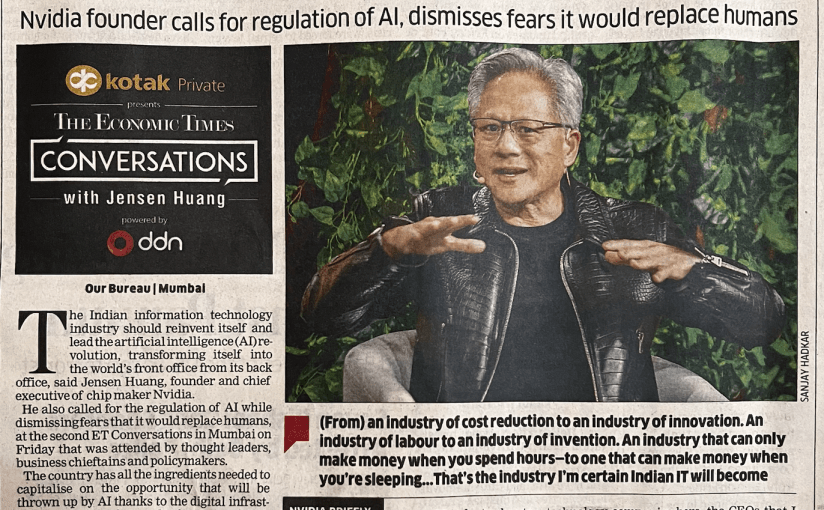


Nvidia’s Jensen Huang: The Future of AI and Humanity

Jensen Huang, the Nvidia founder and CEO, emphasizes a crucial shift in his talk at ET Conversations, urging us to embrace AI to shape our future. In my opinion, this transformation isn’t limited to India but carries global relevance. The key lies in leveraging AI wisely to redefine our roles towards creativity and real-time value creation, aligning with a vision of interconnected humanity.
As we stand at this critical juncture, ponder: Will we adapt to this evolution or risk irrelevance, reminiscent of Kodak, Xerox, Nokia, and other past examples?

Credit – Excerpt from today’s Economic Times.

Note : Yes, the post is enhanced by AI and that’s the whole point of why AI would only help us make things better only after we’ve created “that” thing. So can it replace us in creativity – NO, can it help us remove the manual and repetitive tasks – Yes, and that is a good thing!

Human Attention Span & Technology: Strategies for Focused Work

Internet, Smart phones and Social media have all made our lives easy in unimaginable ways and they have made it really hard for anyone trying to focus on one particular task for a lengthy period of time too. Exploiting these technologies and the way human mind works, we are constantly bombarded by the things which are designed for us to stay glued to the screens for a very long time.
Needless to say, organisations spend millions of dollars every year just to come up with the products that are habit-forming and addictive. In case of social media for instance, it has gone beyond a point where we now see that most content producers on most (if not all) of the platforms are more interested in creating habit-forming, high-intensity contents than focusing on the quality of the message they deliver.

When we were introduced to the internet in the late 80’s (the official DOB of the internet is Jan 1, 1983), little did we imagine that it would change the way we work, spend time, and do pretty much everything.

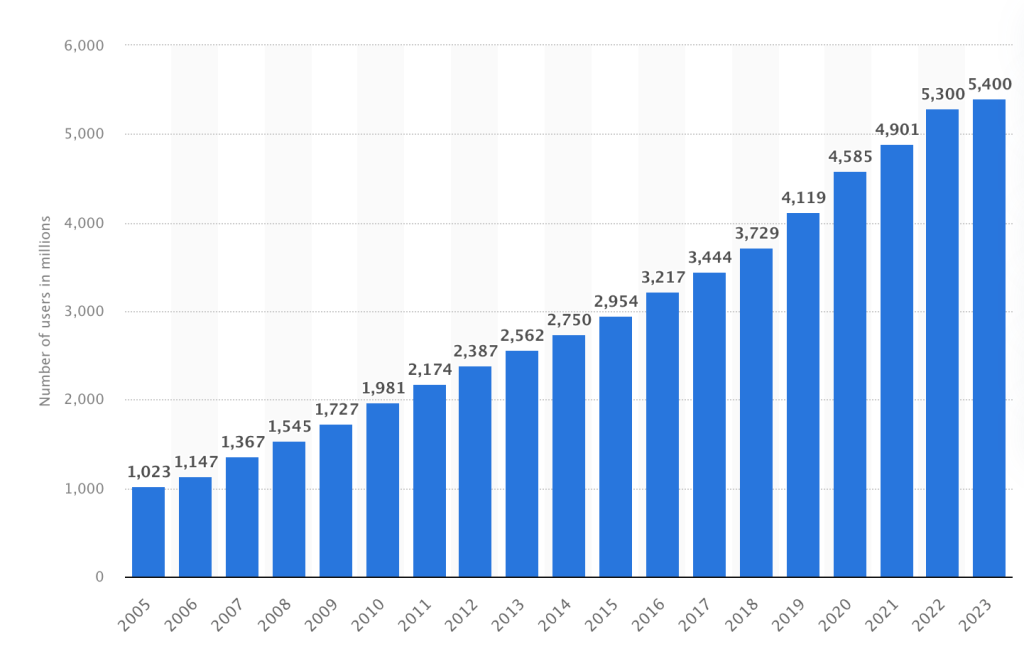
Number of internet users worldwide from 2005 to 2023(in millions)

https://www.statista.com/statistics/273018/number-of-internet-users-worldwide/

Then on February 14, 2005, came a video streaming platform called YouTube, which revolutionised the way we killed our boredom and learnt new things. It made watching videos so easy and fun, that almost everyone who has a mobile device or a computer, uses YouTube as a primary mode of entertainment.
According to Statista, as of April 2024, the United Arab Emirates was the country with the highest YouTube penetration, at approximately 94.2 percent. Israel ranked second with a reach of 93.6 percent, followed by the United Kingdom with a reach of 90.6 percent. The global YouTube reach in April 2024 was approximately 38.1 percent (the average number 38.1% might look odd to some but please know that, almost 90% of the world has penetration of more than 75% and the countries where the penetration is not on par are also the one’s with higher population) Approximately, YouTube users view a 1 billion hours of video each day. That accounts for around 5 billion YouTube videos being watched each day!!!

Most popular YouTube videos based on total global views as of January 2024(in billions)

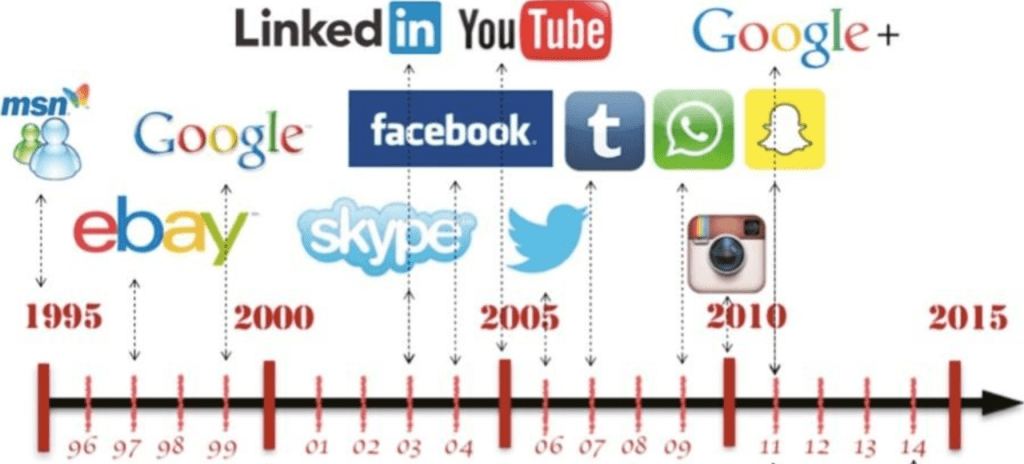
Around the same time we saw the birth of many social media platforms, some of which have ceased to exist and some have become a part of our everyday habits (every-minute in actuality)

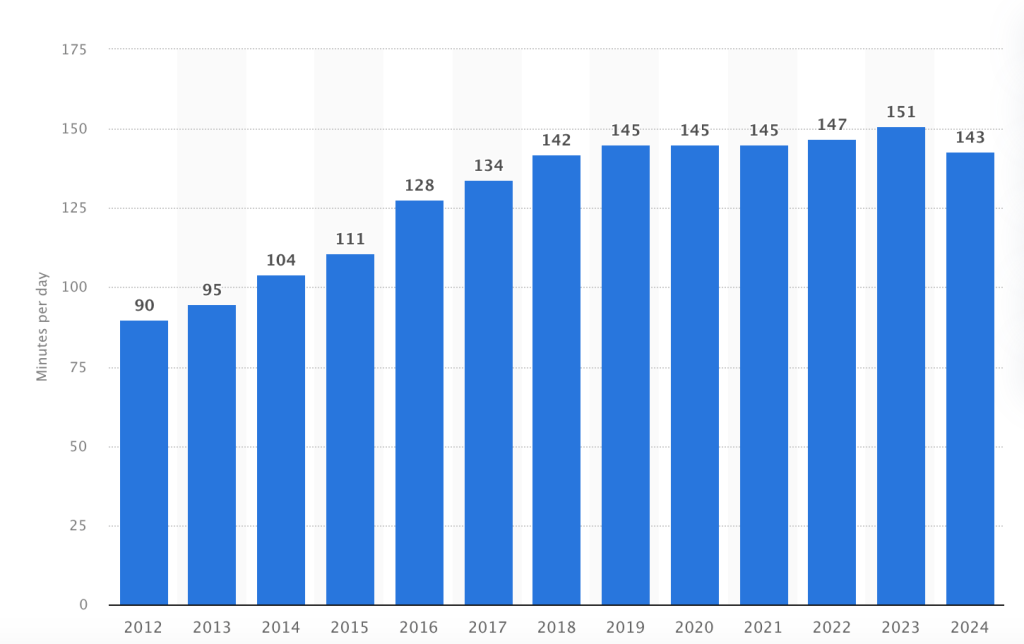
As of 2024, the average daily social media usage of internet users worldwide amounted to 143 minutes per day, down from 151 minutes in the previous year. Currently, the country with the most time spent on social media per day is Brazil, with online users spending an average of three hours and 49 minutes on social media each day. In comparison, the daily time spent with social media in the U.S. was just two hours and 16 minutes. 

Daily time spent on social networking by internet users worldwide from 2012 to 2024 (in minutes)

Currently, the global social network penetration rate is 62.3 percent. Northern Europe had an 81.7 percent social media penetration rate, topping the ranking of global social media usage by region. Eastern and Middle Africa closed the ranking with 10.1 and 9.6 percent usage reach, respectively. 

According to one report that analyses mobile unlocking behaviours, Gen Z smartphone users in the United States unlock their devices on average 79 times daily. Millennials ranked second, averaging 63 unlocks a day, while the Silent Generation had the lowest number of daily unlocks at 18 times per day.

https://www.statista.com/statistics/1050339/average-unlocks-per-day-us-smartphone-users/

Now with all these numbers, one must be feeling overwhelmed and maybe to free themselves of this guilt they might reason themselves to be masters of multitasking.

To disprove the myth of multitasking, here’s the finding of an experiment published in 2001,
Joshua Rubinstein, PhD, Jeffrey Evans, PhD, and David Meyer, PhD, conducted four experiments in which young adults switched between different tasks, such as solving math problems or classifying geometric objects. For all tasks, the participants lost time when they had to switch from one task to another. As tasks got more complex, participants lost more time. As a result, people took significantly longer to switch between more complex tasks. Time costs were also greater when the participants switched to tasks that were relatively unfamiliar. They got up to speed faster when they switched to tasks they knew better.
According to Meyer, Evans and Rubinstein, converging evidence suggests that the human “executive control” processes have two distinct, complementary stages. They call one stage “goal shifting” (“I want to do this now instead of that”) and the other stage “rule activation” (“I’m turning off the rules for that and turning on the rules for this”). Both of these stages help people to, without awareness, switch between tasks. That’s helpful. Problems arise only when switching costs conflict with environmental demands for productivity and safety.
Although switch costs may be relatively small, sometimes just a few tenths of a second per switch, they can add up to large amounts when people switch repeatedly back and forth between tasks. Thus, multitasking may seem efficient on the surface but may actually take more time in the end and involve more error. Meyer has said that even brief mental blocks created by shifting between tasks can cost as much as 40 percent of someone’s productive time.

What can we do to solve this?
While I mostly struggle to focus on a particular task for long myself, for starters, I’ve come to realise that an individual should be aware of his shortcomings which will eventually allow him to take necessary actions to get better and start his journey of being more mindful and more productive in whatever he does going forward.

Cal Newport in his book Deep Work argues that deep work is rare in today’s world, yet it is essential for mastering complicated information and producing high-quality results. Those who cultivate this skill can thrive and differentiate themselves. He sets forth a few rules that help us in making our life a bit more clutter-free and a bit more productive, and they are:
Rule 1: Work Deeply: Create rituals and routines that promote deep work. This can include establishing a conducive workspace, setting defined work blocks, and using time management techniques.
Rule 2: Embrace Boredom: Train your brain to handle boredom by resisting the urge to seek distractions. This builds focus and resilience.
Rule 3: Quit Social Media: Assess the tools you use (especially social media) to determine if they are significantly contributing to your goals. If not, consider quitting or limiting their use.
Rule 4: Drain the Shallows: Reduce the time spent on shallow work. Set strict limits on the amount of time you dedicate to these tasks, allowing more room for deep work.

Additional tips to enhance Deep/Focused work :
Prioritise Tasks: Identify the most important tasks and tackle them during your peak focus hours.
Set Time Limits: Setting up time limits for each work type can drastically increase your chances of focusing on the task at hand and the one which matters.
Create a Dedicated Workspace: Set up an area for focused work that is separate from spaces associated with leisure or distraction.
Practice Mindfulness: Techniques such as meditation can enhance your ability to concentrate and improve overall mental clarity (I am yet to try this personally)
Limit Multitasking: Focused work thrives on single-tasking. Attempting to juggle multiple tasks can dilute focus and reduce overall productivity.
Reflect and Adjust: After focused work sessions, reflect on what strategies were effective and adjust your approach as needed. The more you adjust the approach, the more you will be able to understand what works best for you.
The objective is not to be perfect, it is to get better every single day as we move forward in this journey.

Conclusion :
The numbers, facts and statistics tell us that we humans are spending quite a lot of time being connected to the network and social media, which is definitely decreasing our attention span and our ability to focus deeply. By cultivating the ability to focus deeply, we can produce more meaningful work and lead a more fulfilling professional and personal life.

The question is, will we be humble enough to accept the facts and take corrective actions or continue to stay in the realm of “online world” ? Will we loose our ability to focus deeply altogether and surrender to sudden bursts of motivation or shape the future of humankind due to long lasting inspiration?

References and Further Reading :
On Attention Deficithttps://time.com/6302294/why-you-cant-focus-anymore-and-what-to-do-about-it/
Research on Multi-Tasking and it’s costhttps://www.apa.org/topics/research/multitasking
History of Social Mediahttps://postfity.com/blog/history-social-media
Book – Deep Work by Cal Newport

Be Great!
Praveen.