Good Strategy, Bad Strategy: The Difference That Decides Success

When I was around seven or eight, there was a retailer who was in his early twenties and owned a electronic equipments store. Due due family disputes, he had just parted ways with his older brother who was in the same business for more than a decade . When he started his own store, he was young, had no idea of building a business and all he knew was, how the connections worked on a circuit board. Everyone in our neighbourhood thought he will not survive for more than a year or two without his older brother’s support and eventually he’ll go back to his brother.

However after a few months, his business started to grow. From just fixing things, he started to sell electronic products in his store and after few more months he became a major distributor of some of the products such as tubelights, bulbs, fans, geysers and many more and after a few years he started to take huge contracts from some of the real estate builders in an around our neighbourhood and fifteen years later, he became a major player in south Bangalore electronic equipments sales and had a annual revenue of more than sixty crore Rupees. Whereas his older brother, who had started around a decade earlier had wound up his shop and returned to his hometown.

The reason I remembered Ram Nivas (his real name) for this blog is because whenever I thought about him and his brother, I thought Ram was maybe more passionate, better with people, had better business acumen. But something I have realised after so many years that actually was the reason for this great trajectory is, Ram was better strategically. When he started his own business, he chose a neighbourhood which was growing and still developing. He chose the area where he saw a lot of vacant land and he knew there will be a lot of construction happening soon, which would mean that there will be a lot of demand for his services.

Richard Rumelt (considered as one of the best thinkers on the topic) in his book, Good Strategy/Bad Strategy writes, The first step of making strategy real is figuring out the big ‘aha’ to gain sustainable competitive advantage—in other words, a significant, meaningful insight about how to win.
And that “aha” moment for Ram was to rent a shop in the area where there was hardly anything at that moment but will soon start developing.

In today’s world, most of the organisations have made it a sort of mandate to have a vision and a mission for themselves which is important too, but the problem arises when the organisation and its managers confuse strategy to having a fancy vision and mission statements. A good strategy simply put is, Coherent set of actions designed to achieve a specific goal by leveraging strengths and tackling critical challenges. And a bad one is, Fluffy statements, wishful thinking, vague goals, or long lists of unconnected initiatives.

A good strategy has 3 components,

  • Coherent Actions – A sequence of moves that align.
  • Diagnosis – Identify the real challenge.
  • Guiding Policy – A chosen approach to tackle it.

If organisation A’s mission is to become the market leader (based on customer count) at delivering personalised gifts,
Coherent Actions – Every action of every employee of that organisation should be focused towards accomplishing that task. It would mean every effort, every project, every KPI of that organisation and its employees should be aligned towards achieving that objective.
Diagnosis – Organisation A has to figure out where it is leaking money or loosing its prospects. Could it be, the cost of its products, the quality or maybe their marketing team is not able to market the products appropriately.
Guiding Policy – It has to know the market trends and what the market demands are. Could it be something that the prospects follow on social media, a viral TV series or a song. In simpler terms, constantly doing market research and being on top of any recent trends.

A case study that peaked my interest and inspired me to share the learnings with you all is from the book I mentioned earlier, Richard Rumelt’s “Good Strategy/Bad Strategy” where he breaks down and explains Sam Walton’s strategy with Walmart,

In the 1960s, most big retailers focused on cities and large suburbs, believing rural towns lacked the population to sustain profitable stores. Walton spotted a different truth: these communities were underserved yet had the same appetite for low prices and quality products as city shoppers. The real challenge wasn’t demand—it was figuring out how to serve these customers efficiently at scale.

Instead of chasing urban markets like its competitors Sears or Kmart, Walton committed to small-town dominance. His strategic mantra was Everyday Low Prices (EDLP), not periodic big sales. This single-minded focus meant every operational decision had to align with cost leadership and accessibility.

Walton’s success didn’t come from ambition alone; it came from coordinated, tangible steps that reinforced his guiding policy:

  • Opened stores in clusters around distribution centres to minimise transport costs.
  • Built a centralised logistics system rather than relying on wholesalers.
  • Used computer inventory systems and satellite communications before competitors caught on.
  • Fostered a “save money for the customer” mindset across all employees

Good strategy almost always looks this simple and obvious, discovering the critical factors in a situation and designing a way of coordinating and focusing actions to deal with them. Walton didn’t just dream about being the biggest retailer, he designed a system to make it inevitable.

“A good strategy includes a set of coherent actions. It is about action, about doing something.”

From a single rural store, this clarity of purpose and alignment of execution propelled Walmart into a global retail leader it is today.

“At the core, strategy is about focus, and most complex organizations don’t focus their resources. Instead, they pursue multiple goals at once, not concentrating enough resources to achieve a breakthrough in any of them.” Richard P. Rumelt, Good Strategy Bad Strategy

Now the exact opposite case, a “bad strategy” is of Big Bazaar losing the plot in Indian retail

Once the crown jewel of Future Group, Big Bazaar was India’s answer to Walmart in the early 2000s. It blended the feel of an Indian marketplace with the scale of a supermarket, quickly becoming a household name. But by the late 2010s, cracks in its strategy became too deep to fix—culminating in a collapse accelerated by debt, competition, and the pandemic.

  • E-commerce and organised competitors like Reliance Retail and DMart were building ultra-efficient, low-cost supply chains.
  • Customers were moving towards either high-discount formats (DMart) or convenience-focused online shopping (Amazon, Flipkart, JioMart).
  • Instead of recognizing operational inefficiency and pricing uncompetitiveness as the core problems, Big Bazaar doubled down on store expansion, assuming brand familiarity would keep footfall strong.

Big Bazaar tried to be all things to all customers – discount store, fashion destination, grocery bazaar, electronics seller – without achieving excellence in any one area.

As Rumelt warns:

“When you fail to choose, you try to accommodate conflicting demands and end up with a muddle.”

Big Bazaar’s actions often contradicted each other:

  • Excessive Diversification – Launched sub-brands like FBB (fashion), Food Bazaar (grocery), and eZone (electronics) without building scale advantage in any category.
  • Operational Inefficiencies – Complex supply chains, high rental costs, and poor inventory management meant they couldn’t compete on price with DMart.
  • Delayed Digital Pivot – Launched online initiatives too late, and they lacked integration with store operations.
  • Debt-Fueled Expansion – Opened large-format stores in expensive locations without ensuring profitability.

The Inevitable Downfall :

By the late 2010s:

  • DMart offered lower prices.
  • Amazon/Flipkart offered unmatched convenience.
  • Reliance Retail aggressively captured urban and semi-urban markets.
    Big Bazaar was stuck in the middle, with neither the cheapest prices nor the best experience.
  • The debt burden worsened, COVID-19 slashed footfalls, and in 2022, the brand’s assets were acquired by Reliance Industries.

Bad strategy is long on ambition and short on focus. Big Bazaar wanted to be everywhere for everyone, but ended up being nowhere for anyone.

To Summarise,

A good strategy is a clear, focused plan that identifies the real challenge, sets a guiding policy, and drives a set of coherent actions to overcome it. A bad strategy is vague, full of ambition without focus, ignores key problems, and scatters effort across unaligned initiatives.
In business, success comes from diagnosing the real issues, making deliberate choices, and aligning every action to reinforce those choices, turning intent into impactful results.

PS – If you are wondering what Ram Nivas is upto these days, he has moved on to become a major property builder, owns several rental properties and lives a content life with his wife and 2 daughters.

Be Great!
Praveen.

Artificial Intelligence: Transformative Challenge for Humanity

Through the course of history, we have seen multiple changes in the way we work. Until now we have seen 3 major revolutions in the form of Agricultural, Mechanical and Digital. Human beings have been able to adapt to these changes and in-fact, thrive during and after these transitions. However, we are now at a cusp of another Revolution which is different from all the previous one’s.

This time, the technology not only makes our life easy but also learns from us, adapts to us and possess a unique challenge which might question the very existence of us, the Humans. But before we delve deeper into the “buzz” word AI, it is imperative for us to look back and reflect on the previous shifts we experienced and understand how they played an important role in deciding where we are currently as a society and how the future might look like.

The Industrial Revolution has two phases: one material, the other social; one concerning the making of things, the other concerning the making of men Charles A. Beard

Agricultural Revolution

The Agricultural Revolution, also referred to as the Neolithic Revolution, was a significant turning point in human history that occurred around 10,000 B.C. This period marked the shift from nomadic hunting and gathering societies to settled agricultural communities. Humans began to cultivate crops and domesticate animals for food, which led to a more stable food supply. Common crops included wheat, barley, rice, and maize, while animals such as goats, sheep, and cattle were domesticated.

As agriculture provided a reliable food source, people began to settle in one place, leading to the development of villages and eventually complex societies.As societies became more complex, social hierarchies began to form. Roles became defined, leading to the development of specialised professions and trade. The shift to agriculture had profound effects on culture, religion, and social structures, paving the way for the rise of civilisations.

The Agricultural Revolution laid the foundation for modern society by enabling population growth, the development of cities, and the rise of complex social structures.

Mechanical Revolution

The Mechanical or the Industrial Revolution, which occurred from the late 18th century to the early 19th century, marked a period of significant technological advancement and industrialisation. This revolution was characterised by the transition from hand production methods to machine-based manufacturing processes.

The Invention of machinery and Steam Engine made our lives much easier and contributed to the rise of capitalism, as industrial production led to increased efficiency and profitability. The growth of factories led to mass migration from rural areas to urban centers, as people sought jobs in industrial settings. This contributed to rapid urbanisation and the growth of cities.
It also resulted in changes in labor practices and the nature of work. While the revolution created jobs and increased wealth, it also led to harsh working conditions in factories, child labor, and environmental degradation, prompting social reform movements.

The Mechanical Revolution laid the groundwork for modern industry and fundamentally altered social, economic, and cultural aspects of life, setting the stage for the technological advancements of the 19th and 20th centuries.

Digital Revolution

The digital revolution refers to the shift from analog, mechanical, and electronic technology to digital technology that began in the late 20th century and continues to transform various aspects of life. This revolution encompasses the rise of digital computers, the internet, and related technologies, and has dramatically changed how we communicate, work, and access information.

The widespread adoption of the internet has revolutionised communication, enabling instant access to information, social networking, and global connectivity. The way we consume media has changed dramatically with the advent of digital streaming services, online gaming, and digital publications. The digital economy has led to the rise of new business models, such as e-commerce and gig economy platforms, altering traditional economic structures.

The digital revolution continues to evolve, with emerging technologies like artificial intelligence, blockchain, and augmented reality further shaping the future.

the Future, ArtifIcial Intelligence

Over the summer of 1956, Claude Shannon, the begetter of information theory, and Herb Simon, the only person ever to win both the Nobel Memorial Prize in Economic Sciences and the Turing Award awarded by the Association for Computing Machinery had been called together by a young researcher, John McCarthy, who wanted to discuss “how to make machines use language, form abstractions and concepts” and “solve kinds of problems now reserved for humans”. It was the first academic gathering devoted to what McCarthy dubbed “artificial intelligence” and it set a template for the field’s next 60-odd years.

The following decades saw much intellectual ferment and argument on the topic, but by the 1980s there was wide agreement on the way forward: “expert systems” which used symbolic logic to capture and apply the best of human know-how. The Japanese government, in particular, threw its weight behind the idea of such systems and the hardware they might need. But for the most part such systems proved too inflexible to cope with the messiness of the real world. By the late 1980s AI had fallen into disrepute, a byword for overpromising and underdelivering. Those researchers still in the field started to shun the term.

A decade ago, the best AI systems in the world were unable to classify objects in images at a human level, AI struggled with language comprehension and could not solve math problems. Today, AI systems routinely exceed human performance on standard benchmarks.

In his book, “Work” James Suzman argues that we are in the midst of a similarly transformative point in history, Suzman shows how automation might revolutionise our relationship with work and in doing so usher in a more sustainable and equitable future for our world and ourselves.
But that was in 2020, when he wrote that book and a lot has changed since then. The dramatic rise of AI in last couple of years has been unprecedented and has caused a lot of fear among all the individuals who happened to hear about it and understand a bit of what it is capable of. But this goes without mentioning that the current AI technology still has significant problems. It cannot reliably deal with facts, perform complex reasoning, or explain its conclusions.

AI enables workers to complete tasks more quickly and to improve the quality of their output

Some key takeaways from Standford Univerity’s Annual AI Index Report are,

  • A survey from Ipsos shows that, over the last year, the proportion of those who think AI will dramatically affect their lives in the next three to five years has increased from 60% to 66%. Moreover, 52% express nervousness toward AI products and services, marking a 13 percentage point rise from 2022. In America, Pew data suggests that 52% of Americans report feeling more concerned than excited about AI, rising from 38% in 2022.
  • In 2023, several studies assessed AI’s impact on labor, suggesting that AI enables workers to complete tasks more quickly and to improve the quality of their output. These studies also demonstrated AI’s potential to bridge the skill gap between low- and high-skilled workers. Still other studies caution that using AI without proper oversight can lead to diminished performance.
  • AI beats humans on some tasks, but not on all. AI has surpassed human performance on several benchmarks, including some in image classification, visual reasoning, and English understanding. Yet it trails behind on more complex tasks like competition-level mathematics, visual commonsense reasoning and planning.

AI models can neither create nor solve problems on their own. They are merely elaborate pieces of software, not sentient or autonomous.

AI models can neither create nor solve problems on their own (or not yet anyway). They are merely elaborate pieces of software, not sentient or autonomous. They rely on human users to invoke them and prompt them, and then to apply or discard the results. AI’s revolutionary capacity, for better or worse, still depends on humans and human judgment. Researchers are still getting a handle on what AI will and will not be able to do. So far, bigger models, trained on more data, have proved more capable. This has encouraged a belief that continuing to add more will make for better AI. Research has been done on “scaling laws” that show how model size and the volume of training data interact to improve LLMs.

Regulations

Advances in the past few years have prompted a growing concern that progress in the field is now dangerously rapid—and that something needs to be done about it. Yet there is no consensus on what should be regulated, how or by whom.
The EU has created an AI Office to ensure that big model-makers comply with its new law. America and Britain will rely on existing agencies in areas where AI is deployed, such as in health care or the legal profession. But both countries have created AI-safety institutes. Other countries, including Japan and Singapore, intend to set up similar bodies.

Meanwhile, three separate efforts are under way to devise global rules and a body to oversee them. One is the AI-safety summits and the various national AI-safety institutes, which are meant to collaborate. Another is the “Hiroshima Process”, launched in the Japanese city in May 2023 by the G7 group of rich democracies and increasingly taken over by the OECD, a larger club of mostly rich countries. A third effort is led by the UN, which has created an advisory body that is producing a report ahead of a summit in September.

Summary

AI can automate repetitive tasks, increase productivity and efficiency in various industries. It can analyse vast amounts of data quickly, identifying patterns and insights that might be missed by humans. In healthcare, it can assist in diagnosing diseases, predicting patient outcomes, and personalising treatment plans. AI-powered tools can analyse medical images and detect abnormalities with high precision.

On the other hand however, AI systems can act on existing biases if they are trained on biased data. This can lead to unfair outcomes in areas such as hiring and law enforcement. The extensive data collection required for AI can raise privacy issues due to the potential for misuse. AI systems can be vulnerable to attacks, such as attacks where inputs are manipulated to produce incorrect outputs. This can pose risks in critical applications like cybersecurity and autonomous vehicles or possible future warfare.

    Balancing these advantages and disadvantages is crucial as AI technology continues to develop. Responsible development and deployment of AI can help maximise benefits while mitigating potential risks.

    Human Attention Span & Technology: Strategies for Focused Work

    Internet, Smart phones and Social media have all made our lives easy in unimaginable ways and they have made it really hard for anyone trying to focus on one particular task for a lengthy period of time too. Exploiting these technologies and the way human mind works, we are constantly bombarded by the things which are designed for us to stay glued to the screens for a very long time.
    Needless to say, organisations spend millions of dollars every year just to come up with the products that are habit-forming and addictive. In case of social media for instance, it has gone beyond a point where we now see that most content producers on most (if not all) of the platforms are more interested in creating habit-forming, high-intensity contents than focusing on the quality of the message they deliver.

    When we were introduced to the internet in the late 80’s (the official DOB of the internet is Jan 1, 1983), little did we imagine that it would change the way we work, spend time, and do pretty much everything.

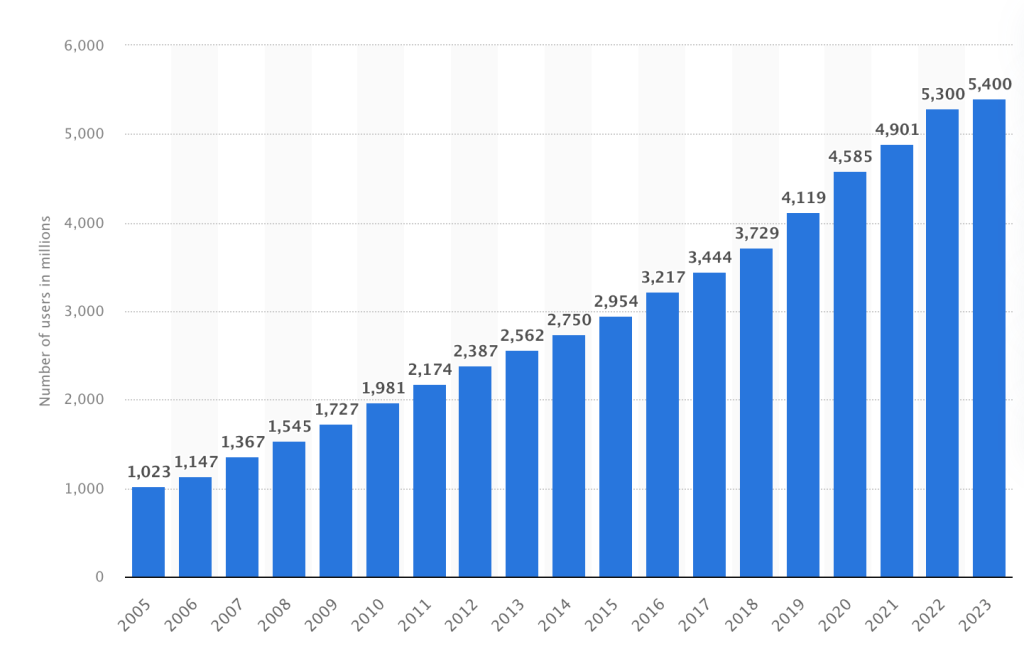
    Number of internet users worldwide from 2005 to 2023(in millions)

    https://www.statista.com/statistics/273018/number-of-internet-users-worldwide/

    Then on February 14, 2005, came a video streaming platform called YouTube, which revolutionised the way we killed our boredom and learnt new things. It made watching videos so easy and fun, that almost everyone who has a mobile device or a computer, uses YouTube as a primary mode of entertainment.
    According to Statista, as of April 2024, the United Arab Emirates was the country with the highest YouTube penetration, at approximately 94.2 percent. Israel ranked second with a reach of 93.6 percent, followed by the United Kingdom with a reach of 90.6 percent. The global YouTube reach in April 2024 was approximately 38.1 percent (the average number 38.1% might look odd to some but please know that, almost 90% of the world has penetration of more than 75% and the countries where the penetration is not on par are also the one’s with higher population) Approximately, YouTube users view a 1 billion hours of video each day. That accounts for around 5 billion YouTube videos being watched each day!!!

    Most popular YouTube videos based on total global views as of January 2024(in billions)

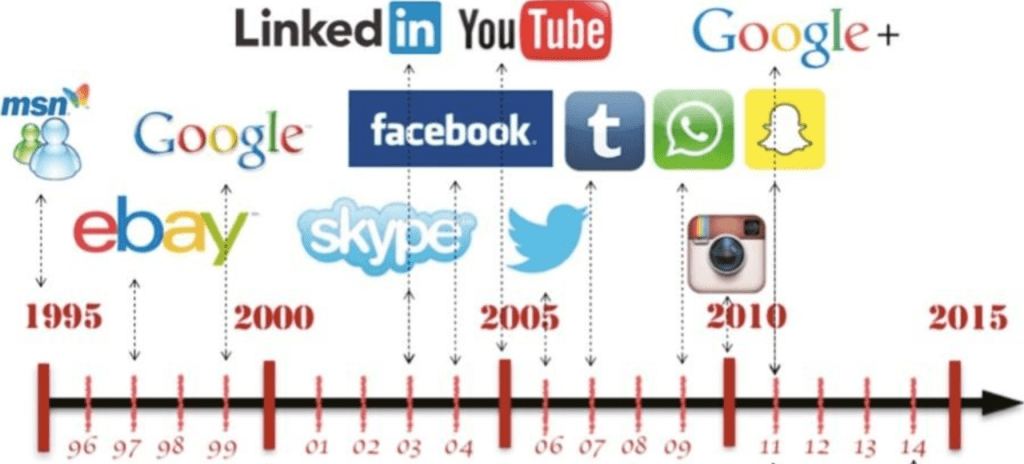
    Around the same time we saw the birth of many social media platforms, some of which have ceased to exist and some have become a part of our everyday habits (every-minute in actuality)

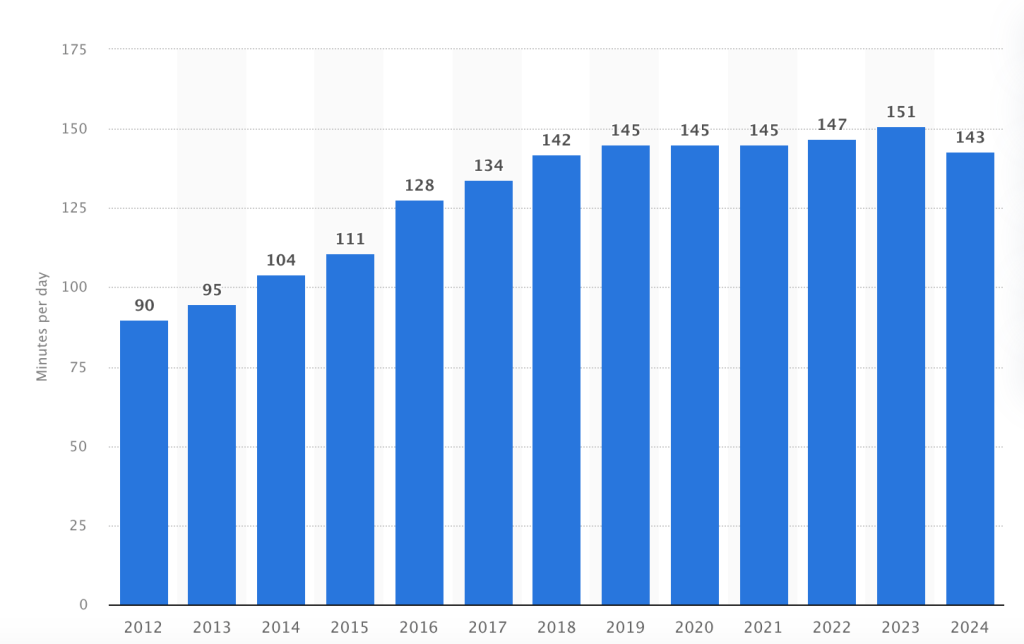
    As of 2024, the average daily social media usage of internet users worldwide amounted to 143 minutes per day, down from 151 minutes in the previous year. Currently, the country with the most time spent on social media per day is Brazil, with online users spending an average of three hours and 49 minutes on social media each day. In comparison, the daily time spent with social media in the U.S. was just two hours and 16 minutes. 

    Daily time spent on social networking by internet users worldwide from 2012 to 2024 (in minutes)

    Currently, the global social network penetration rate is 62.3 percent. Northern Europe had an 81.7 percent social media penetration rate, topping the ranking of global social media usage by region. Eastern and Middle Africa closed the ranking with 10.1 and 9.6 percent usage reach, respectively. 

    According to one report that analyses mobile unlocking behaviours, Gen Z smartphone users in the United States unlock their devices on average 79 times daily. Millennials ranked second, averaging 63 unlocks a day, while the Silent Generation had the lowest number of daily unlocks at 18 times per day.

    https://www.statista.com/statistics/1050339/average-unlocks-per-day-us-smartphone-users/

    Now with all these numbers, one must be feeling overwhelmed and maybe to free themselves of this guilt they might reason themselves to be masters of multitasking.

    To disprove the myth of multitasking, here’s the finding of an experiment published in 2001,
    Joshua Rubinstein, PhD, Jeffrey Evans, PhD, and David Meyer, PhD, conducted four experiments in which young adults switched between different tasks, such as solving math problems or classifying geometric objects. For all tasks, the participants lost time when they had to switch from one task to another. As tasks got more complex, participants lost more time. As a result, people took significantly longer to switch between more complex tasks. Time costs were also greater when the participants switched to tasks that were relatively unfamiliar. They got up to speed faster when they switched to tasks they knew better.
    According to Meyer, Evans and Rubinstein, converging evidence suggests that the human “executive control” processes have two distinct, complementary stages. They call one stage “goal shifting” (“I want to do this now instead of that”) and the other stage “rule activation” (“I’m turning off the rules for that and turning on the rules for this”). Both of these stages help people to, without awareness, switch between tasks. That’s helpful. Problems arise only when switching costs conflict with environmental demands for productivity and safety.
    Although switch costs may be relatively small, sometimes just a few tenths of a second per switch, they can add up to large amounts when people switch repeatedly back and forth between tasks. Thus, multitasking may seem efficient on the surface but may actually take more time in the end and involve more error. Meyer has said that even brief mental blocks created by shifting between tasks can cost as much as 40 percent of someone’s productive time.

    What can we do to solve this?
    While I mostly struggle to focus on a particular task for long myself, for starters, I’ve come to realise that an individual should be aware of his shortcomings which will eventually allow him to take necessary actions to get better and start his journey of being more mindful and more productive in whatever he does going forward.

    Cal Newport in his book Deep Work argues that deep work is rare in today’s world, yet it is essential for mastering complicated information and producing high-quality results. Those who cultivate this skill can thrive and differentiate themselves. He sets forth a few rules that help us in making our life a bit more clutter-free and a bit more productive, and they are:
    Rule 1: Work Deeply: Create rituals and routines that promote deep work. This can include establishing a conducive workspace, setting defined work blocks, and using time management techniques.
    Rule 2: Embrace Boredom: Train your brain to handle boredom by resisting the urge to seek distractions. This builds focus and resilience.
    Rule 3: Quit Social Media: Assess the tools you use (especially social media) to determine if they are significantly contributing to your goals. If not, consider quitting or limiting their use.
    Rule 4: Drain the Shallows: Reduce the time spent on shallow work. Set strict limits on the amount of time you dedicate to these tasks, allowing more room for deep work.

    Additional tips to enhance Deep/Focused work :
    Prioritise Tasks: Identify the most important tasks and tackle them during your peak focus hours.
    Set Time Limits: Setting up time limits for each work type can drastically increase your chances of focusing on the task at hand and the one which matters.
    Create a Dedicated Workspace: Set up an area for focused work that is separate from spaces associated with leisure or distraction.
    Practice Mindfulness: Techniques such as meditation can enhance your ability to concentrate and improve overall mental clarity (I am yet to try this personally)
    Limit Multitasking: Focused work thrives on single-tasking. Attempting to juggle multiple tasks can dilute focus and reduce overall productivity.
    Reflect and Adjust: After focused work sessions, reflect on what strategies were effective and adjust your approach as needed. The more you adjust the approach, the more you will be able to understand what works best for you.
    The objective is not to be perfect, it is to get better every single day as we move forward in this journey.

    Conclusion :
    The numbers, facts and statistics tell us that we humans are spending quite a lot of time being connected to the network and social media, which is definitely decreasing our attention span and our ability to focus deeply. By cultivating the ability to focus deeply, we can produce more meaningful work and lead a more fulfilling professional and personal life.

    The question is, will we be humble enough to accept the facts and take corrective actions or continue to stay in the realm of “online world” ? Will we loose our ability to focus deeply altogether and surrender to sudden bursts of motivation or shape the future of humankind due to long lasting inspiration?

    References and Further Reading :
    On Attention Deficithttps://time.com/6302294/why-you-cant-focus-anymore-and-what-to-do-about-it/
    Research on Multi-Tasking and it’s costhttps://www.apa.org/topics/research/multitasking
    History of Social Mediahttps://postfity.com/blog/history-social-media
    Book – Deep Work by Cal Newport

    Be Great!
    Praveen.

    The Power of Taking Responsibility and Dreaming Big in Our Careers.

    All of us, regardless of our identities and differences desire to achieve more and desire to get to the objective of having our dream job. Some of us, start to think of it seriously at the beginning of our adulthood, some of us start to think of it in the early stages of our careers and some of us little later. But as human beings, we all start to think of that ultimate role or the objective sooner or later which we think will be our life’s purpose.

    However, only few of us plan and strategise for it and most of us end up being who we currently are, even by the end of our careers and some times by the end of our lives too. It is also really important to note however, that all of us blame everyone around us or the circumstances or the environment for not being able to achieve what we always wanted to achieve. Whereas the fact is, only we are responsible to what happens to our careers or what we achieve in our individual lives.

    When it comes to achieving anything in our lives, it is no secret that we need to have a plan, a strategy which will help and guide us in the right direction.

    After carefully thinking (and obviously researching) about that ultimate plan for few months now, I have come up with the four step process which I believe will definitely help all of us in getting closer to our goals in our careers and our lives.

    1. Take Responsibility
    2. Think Big
    3. Plan
    4. Execute

    Taking Responsibility There are obvious reasons for me to put this as the very first thing to do. If we want to achieve anything not only in our careers but also anything in life, without taking full responsibility of our current situation we would not be able to be truthful to ourselves and without being truthful to ourselves, we would not be able to really see our opportunity areas or in simple terms, the areas where we can get better.

    Firstly, we should take a good hard look at ourselves and see who we truly are. See our strengths but at the same time, see our weaknesses. We might be great at coding but probably might not be good with people. Likewise, we might be great with people but probably are not a natural programmer. There are chances that we might be great at both but probably are not good with understanding the business or with time management or probably might not be a good at delegating tasks. The point is, to be crystal clear with ourselves on our strengths and weaknesses. Because without knowing who we truly are, we would not be able to choose the right career path or a business partner or even our life partner.

    Don’t be confused between what people say you are and who you know you are. Oprah

    Think Big I know most of us would have heard or read this somewhere in some form or the other. However, translating it to our individual lives can get a little challenging and a little overwhelming. But, how about “thinking big” keeping small actions in mind? How about thinking of the house we want to build but focussing on the wall that has to be built first?

    Let me break it down for all of us, when we start our career or even in the midway, our objective is mostly to get a high paying job, to get a job where we will be respected, where we matter. However, how about adding another criteria to it? How about understanding where this job or the role will take me in long term? How about understanding, what the organisation is trying to achieve and how that would be a value addition for my long term vision for myself?

    Another thing we often miss in planning our career is, we mostly know what we need to be in next five years and not what we need to be, by the end of our careers. Life is long and we will have long careers, then why just think of next five years? How about knowing what that role will be, by the end of our careers and then planning our next five years which will help us get there.

    If the role (wall) does not help you build your ultimate vision (house) what purpose would it serve?

    “Start small, think big. Don’t worry about too many things at once. Take a handful of simple things to begin with, and then progress to more complex ones. Think about not just tomorrow, but the future. Put a ding in the universe.” Steve Jobs

    Plan Once we have taken the full responsibility of who we truly are and have thought about that ultimate role in our careers, this part is one of the easiest things to do.

    The reason why I say it is the easiest part is, you just have to look for the person who is in that role currently and learn how he got there. You would also want to learn how someone else in the similar role got there sooner. You would also learn the mistakes they made, the sacrifices they had to make, the learnings they took from their experiences and pretty much everything they had to do to get there (you get the idea) and coming up with your own version of it. You take all those learnings and avoid the same mistakes, you make it better, you customise it for yourself and you plan better for yourself.

    “By failing to prepare, you are preparing to fail.” Benjamin Franklin

    Execute Most of the execution will depend on the kind of work we have put in the planning, the plan we have come up with for ourselves. It is following through with that plan every single day, it is that consistency which might soon disappear specially if we encounter a challenge or difficult task.

    Execution in simple terms is, you do what you planned on doing until you get to your objective. If a mentor has recommended you to do a training course on LinkedIn learning or elsewhere, you make sure you do. If you have noticed that the person in that role is good with people, you make sure you do not miss an opportunity to learn and understand human behaviour. If you’ve observed that to become a CTO (chief technology officer) one must be good at understanding the technical language, you learn it and keep up-skilling your technical skills on organisational infrastructure.

    If we have noticed, I spent a lot more time on “Taking Responsibility” and “Thinking Big” sections compared to “Planning” and “Execution” sections and it is by no means just a coincidence. This happens in our careers and lives too. We spend quite a lot of time to achieve our objectives and sometimes get frustrated too, because of it. That is primarily because either we fail to take the full responsibility or we don’t have anything big to achieve and we loose interest.

    “When you establish a destination by defining what you want, then take physical action by making choices that move you towards that destination, the possibility for success is limitless and arrival at the destination is inevitable.” Steve Maraboli – Life, the Truth, and Being Free

    One thing that I did not mention explicitly is Patience. Because it is given, that in most of the cases in our lives, things would not work out the way we would like it to. May be the situation was not right, may be the timing, may be and many more may be’s… But trusting ourselves to follow the process and believing in ourselves will get us where we want to, eventually.

    To summarise, we will be able to achieve anything or get to any role regardless of who we want to be by the end our lives or our careers only if, we take full responsibility, dream big, plan well and execute it really well with a lot of patience.